
There comes a point where ongoing repairs, downtime, and rising costs no longer make sense.
If your aircraft is becoming more of a liability than an asset, here’s how to evaluate the situation and what options you have next.
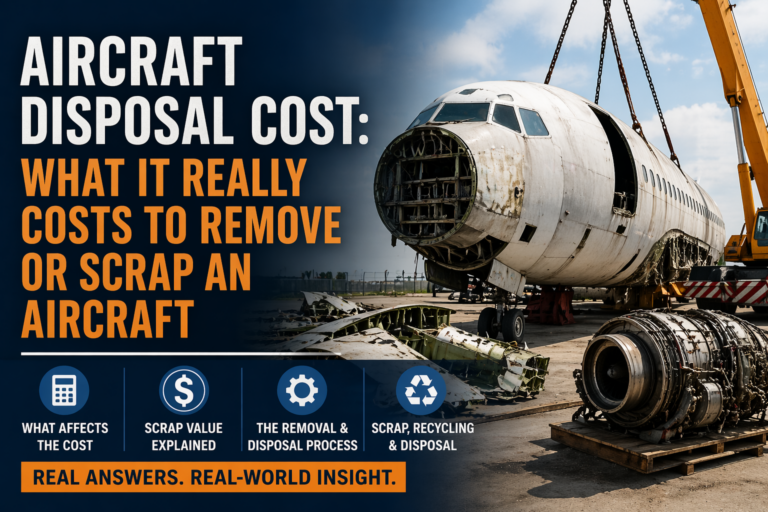
One of the first questions that comes up when an aircraft is no longer in use is cost.
How much does it actually cost to remove it, dismantle it, or scrap it?
The answer depends on more than just the aircraft itself. In most cases, the surrounding environment, access, and condition play just as large a role as the airframe.
Some aircraft can be moved with minimal preparation. Others require full on-site dismantling before anything can be removed. That difference alone can shift the entire scope of the project.
Understanding what drives aircraft disposal cost is the first step in figuring out the most practical way forward.
This situation is more common than most owners expect. What begins as routine maintenance can turn into repeated issues, deferred repairs, and larger component failures that shift the economics of keeping the aircraft operational. Instead of solving problems, each repair cycle starts to uncover new ones.
Major systems like engines, landing gear, avionics, and structural components often play a role in that shift. When multiple areas require attention at the same time, the total cost of repair can quickly exceed the realistic value of the aircraft, especially when factoring in labor, parts availability, and downtime.
There is also the practical side to consider. An aircraft that is frequently grounded or unreliable impacts scheduling, operations, and overall usability. Even if repairs are technically possible, they may no longer make sense from a time or operational standpoint.
At that point, the decision is no longer just about fixing the aircraft. It becomes a question of whether continuing to invest in it is the right move, or if it’s time to consider other options.
If you’re at that stage, you’re not alone. This is a common turning point, and there are clear, practical next steps to consider.
Aircraft are not uniform assets, and disposal is not a one-size-fits-all service.
A small piston aircraft sitting outside with open access is a very different situation from a grounded jet inside a tight hangar at an active airport. The work required to remove each is completely different.
In many cases, cost is driven by constraints. Limited space, safety requirements, equipment access, and coordination with airport operations all influence how the job needs to be handled.
That is why aircraft disposal cost is always evaluated based on the specific aircraft and conditions around it.
.
The main factors that determine cost include:
When an aircraft can be removed with minimal preparation, costs tend to stay lower. When dismantling, staging, and coordination are required, the scope increases quickly.
This is one of the most common questions, and it is also where expectations often need to be adjusted. Many owners look at scrapping as a first option, but understanding the full process of scrap aircraft handling helps explain what is actually recoverable.
Some aircraft do have recoverable value. Engines, avionics, landing gear, and certain structural components can contribute to that. Metals such as aluminum can also be processed through recycling.
However, that value is often offset by the work required to dismantle and remove the aircraft safely.
In some cases, recoverable components or scrap value may help reduce part of the overall cost. In others, especially with older or heavily deteriorated aircraft, the value is limited.
Each aircraft needs to be evaluated individually to determine what, if anything, can be recovered.
.
While every project is different, most aircraft disposal situations fall into general ranges based on complexity.
Smaller aircraft with easy access may fall on the lower end when minimal dismantling is required.
Mid-size aircraft often require partial disassembly and additional coordination, which increases both time and cost.
Larger aircraft and jets typically involve full dismantling, specialized equipment, and more planning, especially when working inside hangars or active airport environments.
For example, a recent Learjet 35 project required full on-site dismantling before removal due to space constraints and condition. Work like this involves sequencing, controlled breakdown, and coordinated removal rather than simple transport.
This is where aircraft disposal becomes a full project rather than a simple task.
*Not sure what your aircraft might cost to remove?
*Send a few photos and your location. In most cases, that’s enough for us to give you a realistic direction on cost and options.
Aircraft disposal typically involves more than just hauling something away.
It starts with evaluating the aircraft and the site. That includes condition, access, and whether dismantling is required.
From there, a plan is developed that outlines how the aircraft will be handled and what equipment will be needed.
If the aircraft cannot be moved intact, controlled dismantling is performed on-site. Major components are separated, and the structure is broken down into manageable sections.
Once dismantling is complete, the remaining material is removed, and the site is cleared for reuse.
This is the same process we follow across a wide range of projects, from smaller private aircraft to full jet dismantling in active airport environments.
This process is closely tied to both aircraft removal and aircraft dismantling services, which often go hand in hand.
.
Most cost surprises come from factors that are not obvious at the start.
Tight hangars, deteriorated structures, limited access, or the need for specialized equipment can all add complexity.
Working in active environments also requires coordination, which adds time and planning.
In most cases, the challenge is rarely just the aircraft itself, but how to safely handle it within its surroundings.
Scrap, recycling, and disposal are often used interchangeably, but they represent different parts of the same process.
Scrap refers to recoverable material value.
Recycling refers to how those materials are processed and reused.
Disposal refers to the full scope of removing the aircraft and handling what remains.
In most real-world situations, all three are part of the same project.
Understanding this helps clarify why aircraft disposal cost is not a single number, but a combination of steps.
If you’re dealing with an aircraft that’s no longer worth repairing or sitting unused, the fastest way to understand cost is to have it evaluated.
Send a few photos, the location, and any basic details. That is usually enough to determine what the project will involve and what your options look like.
In some cases, recoverable components or materials may help reduce part of the overall cost, depending on the aircraft and condition.
We handle aircraft removal, dismantling, and disposal projects nationwide and typically respond within 24 hours.
Send a few photos and location, that’s usually enough for us to take a look.