
If you’re looking at an aircraft that’s no longer flying, the question usually comes up quickly: Is it worth anything, or is it time to scrap it?
If your aircraft is becoming more of a liability than an asset, here’s how to evaluate the situation and what options you have next.
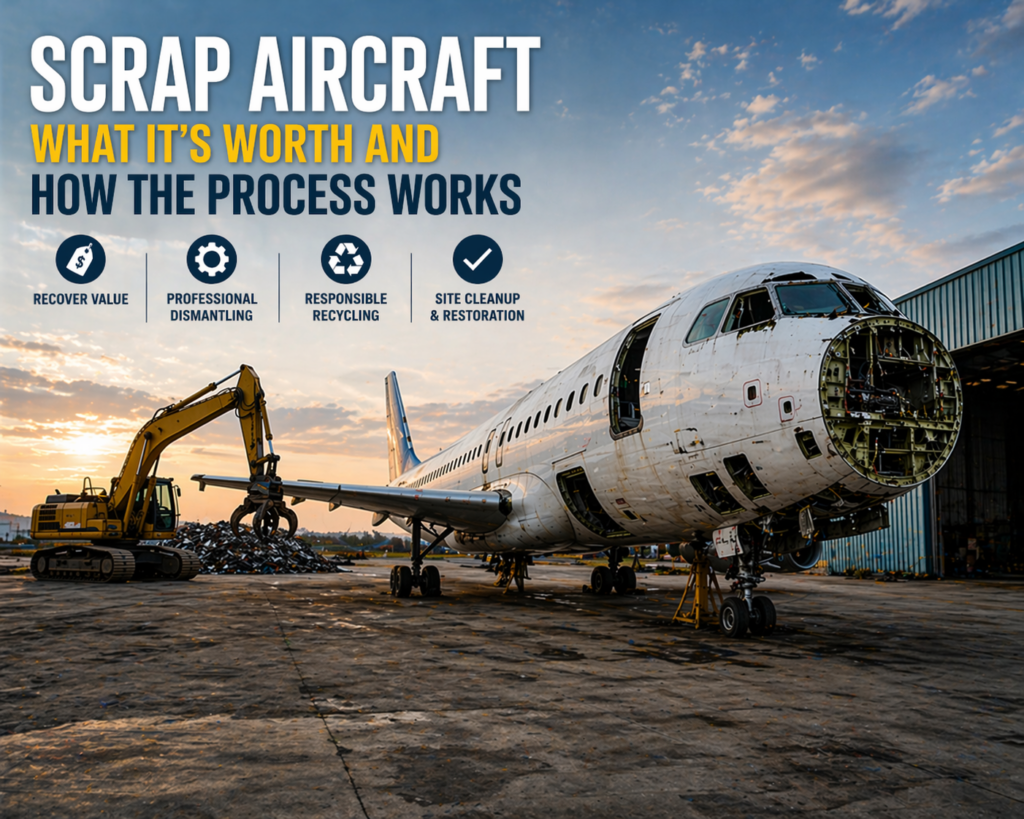
Aircraft rarely go straight from active use to scrap overnight.
Most of the time, it’s a gradual process. Maintenance gets more expensive. Parts become harder to find. Downtime increases. What used to be routine upkeep turns into larger, more frequent issues.
Eventually, the cost and effort required to keep the aircraft operational outweigh its usefulness.
This is the point where many owners begin considering whether it makes more sense to scrap the aircraft rather than continue investing in it.
In some cases, aircraft that reach this stage also become long-term storage or even abandoned aircraft situations, especially when no clear plan is in place.
Scrapping an aircraft is not just a matter of cutting it up and hauling it away.
It is a structured process that typically includes several steps working together.
The aircraft is first evaluated to determine its condition, location, and what can realistically be recovered. From there, a plan is built around how it will be dismantled, removed, and processed.
In many cases, this involves aircraft dismantling services, where major components such as wings, tail sections, and internal systems are separated on-site before anything can be moved.
Once dismantled, components that still have value may be recovered. The remaining materials are then processed through aircraft recycling or handled as part of a full aircraft removal process.
Scrap, recycling, and disposal are not separate decisions. They are different parts of the same overall process.
.
This is where expectations often need to be reset.
Many people assume that a large aircraft automatically means high scrap value. In reality, value depends far more on condition and components than size alone.
Aircraft with usable engines, avionics, or intact systems may have some recoverable value. Aluminum and other materials can also contribute through recycling.
However, that value is usually offset by the work required to safely dismantle and remove the aircraft.
In some cases, recoverable components or materials may help offset part of the overall cost. In others, especially with older or heavily deteriorated aircraft, the value is limited.
Understanding this balance is key. Scrapping is not just about what the aircraft is worth. It is about what it takes to handle it properly.
One of the biggest misconceptions is that scrap value and removal cost are separate.
In reality, they are directly connected.
The effort required to dismantle an aircraft, manage logistics, and clear the site often exceeds the raw value of the materials alone. That is especially true when working in hangars, tight spaces, or active airport environments.
This is why scrapping is best viewed as a full project rather than a simple transaction.
In some situations, value helps offset cost, not eliminate it.
In most situations, the focus is on removing the aircraft to restore the space for normal operation.
.
Scrapping an aircraft is typically the most practical option when:
These situations often overlap with what many owners experience when an aircraft reaches the point of no longer being worth repairing (/aircraft-not-worth-repairing).
Every aircraft is different, but the main factors that influence both value and cost include:
These factors determine not only what can be recovered, but how complex the overall project will be.
.
Once an aircraft is evaluated, the process usually follows a structured path.
The aircraft is assessed for condition and access. A plan is developed for dismantling and removal. If necessary, the aircraft is broken down into manageable sections on-site.
Components are separated, materials are sorted, and everything is prepared for removal. Once cleared, the site is cleaned and returned to usable condition.
This is the same approach used across a wide range of projects, from smaller private aircraft to larger jets in active airport environments.
If you’re trying to decide what to do with an aircraft, the fastest way to get clarity is to have it evaluated.
Send a few photos, the location, and any basic details. In most cases, that is enough to determine whether scrapping makes sense and what the process would look like.
In some situations, recoverable value may help reduce part of the overall cost. In others, the focus is simply on removing the aircraft safely and efficiently.
We handle aircraft dismantling, removal, and disposal nationwide and can walk you through the most practical option based on your situation.
We typically respond within 24 hours.
Send a few photos and location, that’s usually enough for us to take a look.